

OTTEWILL SCHOLARSHIP
Closure of the Ottewill International Travel Scholarship
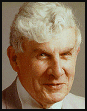
Professor Ronald Harry Ottewill, OBE FRS (1927-2008)
Ron Ottewill had a distinguished academic career, initially at the University of Cambridge and then from 1964 at the University of Bristol, where he held the prestigious Leverhulme Chair of Physical Chemistry from 1982 until his formal retirement in 1992, though he continued to be active in research for more than a decade beyond his retirement. He was one of the outstanding international researchers in the field of colloid and interface science, and played a pioneering role in the early research on the synthesis, properties and applications of polymer colloids of all kinds.
The Ottewill International Travel Scholarship was set up in honour of Ron Ottewill by the UK Polymer Colloids Forum (UKPCF) to use up the residual reserves on its formal closure in 2016 with the funds continuing to be managed through Macro Group UK of which UKPCF had been a sub-group. The Scholarship was designed to assist, each year, one outstanding UK-based graduate researcher, whose research related to polymer colloids, in presenting their work at an international conference outside the UK with a travel award of up to £1,000. The award committee comprised Brian Vincent (University of Bristol), Peter Lovell (University of Manchester) and Craig Jones (Unilever). The Scholarship is now closed, so the purpose of this note is to announce the closure and to highlight the researchers who have benefitted from being awarded Scholarships:
Year
2017
2018
2019
2020
2021
2022
2023
2024
University
Cambridge
King’s College
Warwick
Birmingham
Warwick
Liverpool
Hertfordshire
Cambridge
Supervisor
Alex Routh
Mark Green
Stefan Bon
Rachel O’Reilly
Matthew Gibson
Tom McDonald
Michael Cook
Alex Routh
Their conference reports are available as PDFs using the links embedded in their names. Note that the award committee made allowances in delaying use of the travel award to account for disruptions arising from COVID or ill health of a recipient.